 ;
;



Späth organ - Hl. Geist
 ;
;
Source: Schramberger Orgelkonzerte
In the second manual - set up as a swell - there are not only the aliquots but also the three manual reed parts bassoon 16', trumpet 8' and clairon 4'. The first manual contains the complete principal series from the 16' to the non-repeating mixture. Harmony and concert flute are constructed as overblowing registers. Six registers, supplemented by the gently floating Vox coelestis, belong to the string family. By super- and sub-coupling, the rich color of the registers can be fully exploited and the organ sound can be increased to a magnificent fullness. Two free combinations and a register crescendo are included as playing aids. In 1994 the instrument was restored by the organ manufacturer Vleugels, Hardheim.
Disposition
| I. Manual Great organ C-g''' |
II. Manual Swell organ C-g'''(') |
Pedal C-f' |
|---|---|---|
| Principal 16' | Bourdon 16' | Prinzipalbass 16' |
| Principal 8' | Hornprincipal 8' | Violonbass 16' |
| Gamba 8' | Viola 8' | Subbass 16' |
| Gedeckt 8' | Quintatön 8' | Zartbass (Tr.) 16' |
| Harmonieflöte 8' | Konzertflöte 8' | Oktavbass 8' |
| Gemshorn 8' | Nachthorn 8' | Cellobass (Tr.) 8' |
| Salicional 8' | Aeoline 8' | Posaune 16' |
| Dolce 8' | Vox celest 8' | |
| Rohrflöte 4' | Zartflöte 4' | |
| Oktav 4' | Prestant 4' | |
| Oktav 2' | Quint 2 2/3' | |
| Mixtur 3-4f 2 2/3' | Piccolo 2' | |
| Terz 1 3/5' | ||
| Fagott 16' | ||
| Trompete 8' | ||
| Clairon 4' | ||
| Tremolo |
Couplers
II/I II/P I/P I/P4' I/4' I/16' II/4' II/16' II/I 4' II/I 16'
Snaps
Tutti, fr.Comb.1, fr.Comb.2, Auslöser, Handreg. ab, Zungen ab, Auslöser
Pedal
1st Manual Normal position
2nd Manual Normal position
Organ swell pedal
Register crescendo
(also as hand lever)
Pneumatic cone shutter
Wind pressure in the main and pedal mechanism 125 mm WS, in the swell 95 mm WS
The disposition, with its rich 8' palette, is still rooted in Romanticism, but with its reeds and aliquots it takes up the principles of the Alsatian organ reform. The comparison of the mixture plenum in the first manual and the tongue plenum in the second manual is interesting. In the newspaper report about the inauguration, the instrument was therefore assigned to the "French-English-American organ type". Thanks to the many sub- and super-octave couplings, the sound of the organ can be increased to "magnificent" (Bernd Sulzmann in his report from 1990).
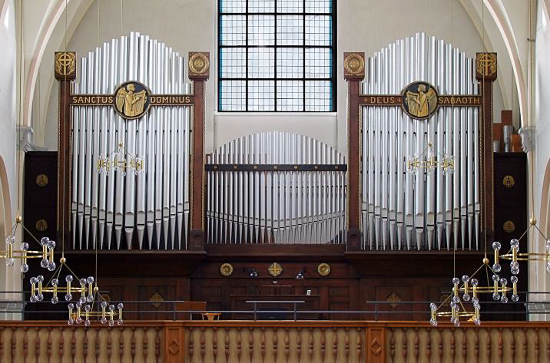
The organ facade extends across the entire width of the gallery and is divided into three front panels separated by pilaster strips. The scrolls and the medallions with the harp-playing angels, as well as the attachments on the pilaster strips, were removed during an interior renovation of the church in 1962. Otherwise, the organ survived the decades undamaged.
Thanks to generous support from the State Monuments Office and the Diocese of Rottenburg-Stuttgart, the organ was able to be fundamentally restored between 1992 and 1994 by the Vleugels company from Hardheim. The lost decorations were also reconstructed using old photographs. In addition to the usual work, measures were taken to dampen the strong noise generated by the cone shutters. All spaces in the membrane strips were closed with spruce strips, the cones of the pedal tray were covered with double leather and the guide pins of the cone scissors were covered with silicone tubing to avoid rattling noises. To ensure that the valve wires in the guide holes do not come into contact with the wood, felt rings were glued to the fundamental boards.
The Späth Organ of the Church Heilig Geist is today a valuable sound and architectural monument of an era from which only a few completely preserved instruments of this size have been preserved. "This type of organ is completely in its element when it comes to everything from romantic timbres to symphonic sound towers." writes the Rottenburg cathedral organist and episcopal organ expert Wolfram Rehfeldt in his greeting to the re-inauguration. But even when used in the liturgy, this instrument offers a richness of colors not found in "modern organs", which can be used imaginatively in literary playing, improvisation and, last but not least, for accompaniment purposes.